


Fruit Ninja®
Halfbrick Studios
Some mobile games ask for patience before they become enjoyable. Fruit Ninja® does the opposite: I can open it, start cutting fruit almost immediately, and understand the basic pleasure without reading a long tutorial. That instant clarity is still its strongest quality. It is an arcade game from Halfbrick Studios built around quick reactions, clean gestures, and the satisfying feeling of turning a busy screen into a burst of sliced fruit.
After spending time with it, I see why it has remained so recognizable. The game is easy to pick up, but it is not completely empty once the novelty fades. Better runs depend on timing, restraint, and learning when not to swipe. It works well when I have only a few spare minutes, yet it can also pull me into repeated attempts when I am trying to improve a score or simply beat my previous rhythm.
That said, its simplicity is both its advantage and its limitation. If you want a deep arcade system with a long campaign, detailed progression, or a constantly changing world, this is not the right choice. If you want a familiar, low-friction game that gives you something to do while waiting for a bus, during a short break, or before bed, it remains remarkably effective.
Related News

Fruit Ninja®: The Timeless Appeal of Digital Slicing

Granny: The Chilling Game Gripping Mobile Gamers

Hungry Shark Evolution: Conquering the Mobile Arcade Seas
Why the first few seconds still work
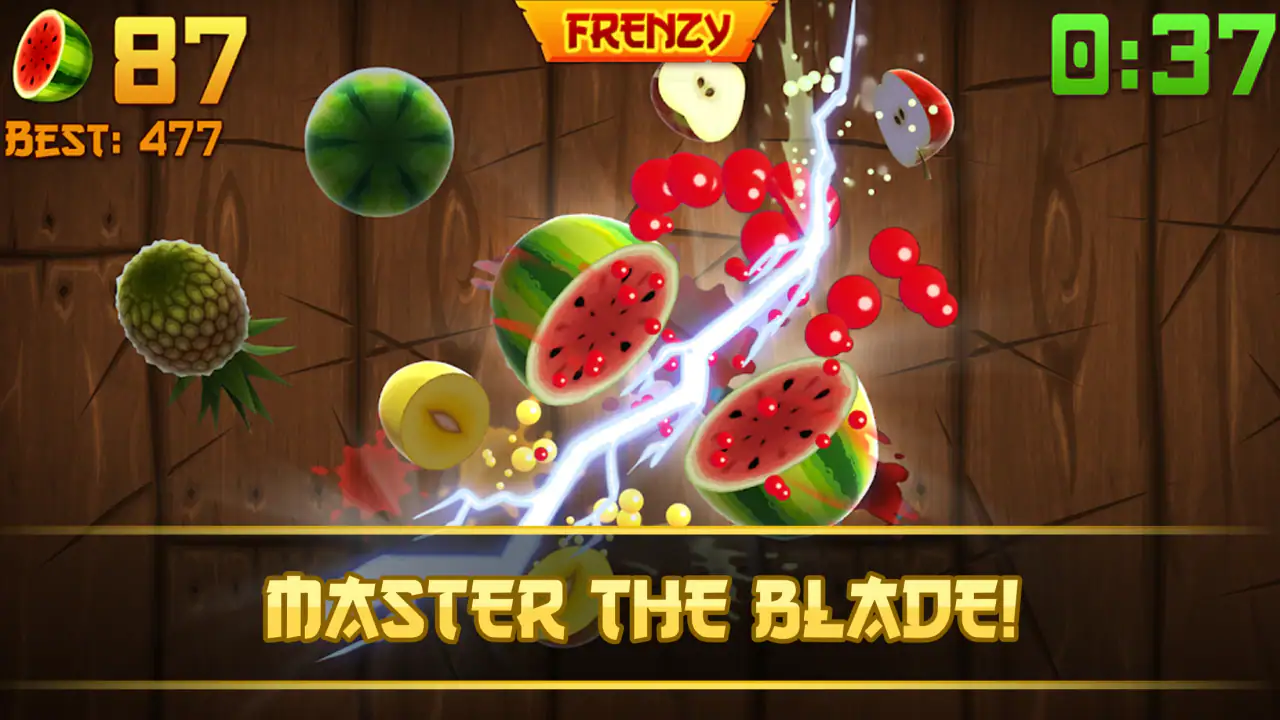
The opening experience is unusually direct. I do not need to learn a complicated control scheme: the main action is a finger swipe across the screen, and the visual result is immediate. Fruit appears, I cut through it, and the game communicates success through motion, sound, and the satisfying disappearance of the target. That relationship between gesture and response makes the game feel responsive even during a very short visit.
This is where the arcade design earns its place. Many casual games use simple controls, but they surround them with menus, timers, energy systems, or long explanations. Here, the central action remains easy to understand. A new player can hand the phone to a friend and explain the idea in a sentence. I find that especially useful when I want a game that does not demand mental preparation.
Related News

Why WhatsApp Messenger Still Makes Everyday Communication Feel Easy

Jurassic World: The Game Is the Better Dino Tycoon for Strategic Players

Threads in Real Life: Who Should Join, Lurk, or Leave

How SHEIN Turned Shopping Into an Endless Content Feed

How to Make Fortnite Feel Smarter on Mobile

Should You Switch to Microsoft Outlook on Mobile?
The visual language also helps with immediate pleasure. Fruit is large enough to recognize quickly, the targets invite a natural slicing motion, and the screen gives me a clear sense of what I have hit. I am not searching through a cluttered interface to find the next objective. My attention stays on movement and timing, which is exactly what a short-session arcade game should do.
The game is free, which makes trying it easy, although in-app purchases range from under a dollar to well over a hundred dollars per item. That wide range is worth keeping in mind before spending. I can enjoy the basic appeal without treating purchases as part of the entry requirement, but anyone who likes collecting or customizing content should approach the optional spending carefully and decide on a personal limit first.
Its broad reach is easy to understand. The game is rated for Everyone, and its core interaction avoids the complexity that often prevents younger players or non-gamers from joining in. At the same time, the timing challenge gives adults a reason to return. It is not aimed at one narrow type of player; it is more like a digital reflex toy that happens to offer enough competition with yourself to stay interesting.
Gallery
A rhythm built for spare minutes
My favorite way to use Fruit Ninja is in small, clearly defined sessions. I might play while waiting for an appointment, take a few attempts after finishing a task, or use it as a quick change of pace between more demanding activities. The game does not require me to remember a story, manage a large inventory, or reconstruct a complicated plan after a break. I can simply begin again and let my hands take over.
That makes the session rhythm unusually forgiving. A good attempt can feel exciting because several successful swipes flow together, while a poor attempt ends without making me feel that I have lost a long investment of time. The cost of failure is mostly the desire to try once more. For me, that is a better fit for casual play than games that punish a missed day or expect a daily routine.
The best results come from treating each swipe as a decision rather than waving at everything on screen. When several pieces of fruit appear together, a broad, hurried motion may feel natural, but controlled movement is often more useful. I try to watch the whole arrangement before moving, then choose a line that reaches multiple targets without turning the screen into guesswork. This small change makes the game feel less like random tapping and more like a test of visual planning.
Another practical habit is to avoid chasing every tempting target. A player who reacts to each piece separately can lose a sense of spacing and timing. I get more consistent runs when I keep my finger movement smooth and leave room to respond to what appears next. That is a non-obvious strength of the design: the game looks frantic, but improvement comes from becoming calmer inside the frantic moments.
Short sessions also reveal how immediate pleasure differs from long-term depth. The first few rounds are enjoyable because the basic action is tactile and readable. Later, the challenge comes from refining reactions and trying to maintain concentration. If I am tired or distracted, I can still have a pleasant round, but the game makes my inconsistency obvious. It is a light experience, not a mindless one.
Returning after an interruption
Many mobile games are awkward when real life interrupts them. A message arrives, someone needs my attention, or I simply put the phone down and forget what I was doing. Fruit Ninja handles that kind of casual use better than a story-driven game because there is no narrative thread to lose. When I return, I do not need to remember a mission, a conversation, or a complicated objective.
That does not mean every interruption is harmless. A round based on fast reactions is not something I can casually leave in the middle and expect to resume with the same concentration. The useful distinction is that the game is interruption-tolerant at the session level, not necessarily at the exact moment of a swipe. I can stop between attempts and come back later without friction, but I should not expect a paused moment to preserve the same flow as an uninterrupted run.
This makes it a good companion for uncertain waiting time. If I have only two minutes, I can play without worrying that I have started something too large. If I suddenly get more time, I can continue with another attempt. The game respects that flexible pattern better than alternatives that depend on long levels or a fixed sequence of objectives.
I also appreciate that returning does not require a warm-up period. The controls are simple enough that my first swipe after a break still makes sense. In more demanding arcade games, a short absence can make the controls feel unfamiliar or force me to relearn a character’s movement. Here, the physical idea of slicing is so direct that the barrier to re-entry stays low.
For parents or people sharing a device, that simplicity can be useful too. A player can explain the basic interaction quickly, and the Everyone rating makes the game suitable for a broad audience. Still, the speed of the action means very young children may enjoy the gesture without necessarily understanding the timing challenge. I would treat it as an accessible game to try together, rather than assuming every age group will engage with it in exactly the same way.
Where replay value comes from
The main question is whether slicing fruit remains interesting after the first burst of novelty. In my experience, replay value depends heavily on what I want from the game. If I need a changing adventure, the answer is no. The central activity remains focused on cutting fruit and improving how I react. There is no need to pretend that this is a deep replacement for a larger arcade package.
However, repetition is not automatically a weakness in this genre. A good arcade game can make the same basic action feel different when my attention, timing, and confidence change. One attempt may be relaxed, another may become a personal challenge, and a third may be about testing whether I can stay controlled when the screen becomes busier. The content may be familiar, but my performance is not identical each time.
The game’s long-term appeal therefore comes from mastery rather than discovery. I can work on cleaner swipes, better anticipation, and fewer impulsive movements. A useful personal rule is to choose one improvement target per session. Instead of vaguely trying to “do better,” I might focus on avoiding rushed gestures or keeping my movement compact. That turns repetition into practice and gives a short visit a clearer purpose.
There is also a social side to this kind of replay, even when I am playing alone. A simple score or personal best creates an understandable benchmark. I do not need a complex ranking system to know whether a run felt successful; I can compare my current result with what I achieved earlier. This is less demanding than competitive multiplayer and less socially exposed, which suits players who enjoy improvement without wanting to coordinate with others.
Still, players who are sensitive to repetitive loops may reach the limit quickly. The same clarity that makes the game approachable can make it feel narrow after extended play. I would not recommend installing it as someone’s only game. It works best alongside games that provide exploration, puzzles, strategy, or narrative variety. As a small arcade option, its focused design is a benefit; as a complete entertainment diet, it may become predictable.
How it compares with other casual arcade choices
Compared with puzzle games, Fruit Ninja asks for less planning and more real-time reaction. I do not need to build a chain of logical moves or wait for a board to reveal a solution. That makes it better when I want immediate physical interaction, but worse when I want a calm mental exercise that I can pause while considering a move.
Compared with endless runners, it is less about steering through a continuous route and more about reading individual moments. I am not guiding a character through a world or memorizing a path. The screen itself is the challenge. That difference matters when choosing a game for a particular mood: runners can create a stronger feeling of travel and momentum, while this one delivers a more compact burst of hand-eye coordination.
Compared with rhythm games, it shares the pleasure of matching action to timing, but it does not ask me to follow a song or maintain a musical pattern. That makes it easier to play without sound or without committing to a particular mood. On the other hand, rhythm games may offer a stronger sense of structure for players who enjoy music-based progression.
Its clearest advantage over many alternatives is the low mental overhead. I can pick it up without remembering where I left off. Its clearest disadvantage is that the same low overhead can reduce the sense of journey. If I want a game that rewards long-term planning, a puzzle or strategy title will probably serve me better. If I want something that begins paying off immediately, this remains one of the safer choices in casual arcade gaming.
Practical details before installing
Halfbrick Studios has kept the game recognizable across a long lifespan. It was released on July 20, 2011, and the current version is 3.93.3. On Android, it requires at least version 6.0 of the operating system. Those details matter mainly because the game is not a new experiment built around a temporary trend; it is an established title that has continued to receive a current version while preserving its straightforward identity.
The scale of its audience is also considerable, with over 500 million installs and an average rating of 4.5 from around 5 million ratings. I do not treat popularity as proof that every player will enjoy it, but those figures fit my experience of a game that is easy to understand and easy to recommend casually. It has the kind of design that can appeal to someone who rarely plays mobile games as well as to someone looking for a quick reflex challenge.
Because it is free to start, I would install it for the basic play rather than for a promised collection of extras. Before making any purchase, I would spend several sessions deciding whether the core loop itself holds my attention. If slicing fruit is already enjoyable without additions, optional spending becomes a personal choice rather than a requirement for discovering the game’s appeal.
One small but important consideration is the difference between a quick session and an extended session. The game is excellent at delivering a few focused attempts, but long stretches can expose the repetition. I would set a natural stopping point, especially if I notice myself swiping mechanically instead of responding thoughtfully. That habit preserves the freshness of the game and prevents a pleasant arcade break from turning into a dull routine.
Who should play it, and who should skip it
I would recommend it to anyone who wants an arcade game with almost no learning curve, especially people who play in irregular bursts. It suits commuters, casual players, families looking for a simple shared activity, and experienced mobile gamers who want something lighter between larger games. The strongest audience is someone who values immediate feedback more than story, exploration, or elaborate progression.
I would be more cautious recommending it to players who need constant novelty. If you lose interest when the central mechanic repeats, the clean design may feel limited rather than elegant. It is also not the best choice for someone seeking a quiet, turn-based experience, because successful play depends on attention during fast moments. A puzzle game may be a better alternative when you want to think slowly, and a runner or rhythm game may be better when you want a stronger sense of movement or musical structure.
Players who dislike optional purchase pressure should also decide in advance how they want to use a free game with in-app items. I can enjoy the basic experience without making it part of my routine to buy extras, but the listed purchase range is broad enough that a clear spending boundary is sensible. That is not a reason to reject the game outright; it is simply part of using free-to-start mobile games responsibly.
The most useful way to approach it is as a focused tool for short entertainment, not as a promise of endless variety. I open it when I want a quick reaction challenge, play until my attention drops, and leave before the repetition becomes the main thing I notice. That relationship gives the game room to succeed on its own terms.
My casual verdict
Fruit Ninja remains effective because it understands the value of an immediate answer. I swipe, something happens, and I know at once whether the movement worked. That clarity makes it unusually good for spare minutes and uncertain schedules. It does not ask me to invest emotionally before offering enjoyment, and it does not punish me for returning after a long gap between sessions.
Its replay value is more personal than expansive. I return to improve my timing, find a smoother rhythm, or enjoy the small satisfaction of a clean run. When I expect new worlds and major surprises, it feels repetitive. When I expect a compact arcade challenge that can start and stop easily, the narrow focus becomes exactly what I want.
With over 500 million installs, a 4.5 average, and a free starting point, it is easy to see why the game has reached so many players. I would not install it for deep progression or a rich narrative. I would install it because the basic action is still pleasant, the sessions are flexible, and the learning curve is almost nonexistent.
My recommendation is simple: try it if you want immediate, interruption-friendly arcade fun, but keep your expectations centered on short sessions and personal improvement. That is where this game is at its best. It is not the most varied mobile experience I have played, yet it remains a dependable choice when I want a few minutes of clear, tactile entertainment without a complicated commitment.
FAQs for Fruit Ninja®
What is Fruit Ninja® and how do I play it?
Fruit Ninja® is a fun and addictive arcade game where players slice fruits that are thrown into the air using swipes on their screens. The goal is to slice as many fruits as possible while avoiding bombs. The game offers different modes, including Classic, Zen, and Arcade, each providing a unique challenge and experience.
Is Fruit Ninja® free to download and play?
Yes, Fruit Ninja® is free to download on both Android and iOS platforms. However, the game offers in-app purchases that enhance gameplay, such as additional blades, dojos, and power-ups. While these purchases can enhance the gaming experience, they are optional, and the game can be enjoyed without spending money.
What are the main features of Fruit Ninja®?
Fruit Ninja® includes various features like multiple gameplay modes, customizable blades and dojos, and power-ups to boost your score. The game also offers daily challenges and leaderboards to compete with friends and players worldwide. Regular updates keep the game fresh with new content and events.
Does Fruit Ninja® require an internet connection to play?
Fruit Ninja® can be played offline, which makes it a great option for on-the-go gaming without an internet connection. However, some features, such as leaderboards, daily challenges, and certain updates, may require an internet connection to access fully and enjoy all aspects of the game.
Is Fruit Ninja® suitable for all ages?
Fruit Ninja® is suitable for players of all ages, featuring simple controls and family-friendly content. The game’s vibrant graphics and engaging mechanics make it appealing to both children and adults. However, parents should be aware of in-app purchases and ensure that appropriate settings are enabled to prevent unintended purchases by younger players.
Pros
- Engaging and intuitive gameplay.
- Wide variety of challenging levels.
- Vibrant and colorful graphics.
- Smooth performance on most devices.
- Great for quick
- fun sessions.
Cons
- In-app purchases can be pricey.
- Limited free content updates.
- Ads can interrupt gameplay.
- Requires internet for some features.
- May drain battery quickly.


